Essentials Where to stay Festivals HK Island Kowloon Islands & New Territories Hikes Food Itineraries Day trips Practical info

Hong Kong — neighbourhood guide

A neighbourhood-by-neighbourhood guide — tried and tested

↓

Before you go to Hong Kong

Everything you need to know before you set foot in Hong Kong.

📍 Geography in a nutshell

Hong Kong isn't just Hong Kong Island. There's also Kowloon (the peninsula across the water, attached to the mainland), the New Territories (further north), and a whole bunch of islands, including Lantau (where the airport is). The Island is the business and colonial side. Kowloon is the working-class, buzzing side. You absolutely have to do both.

🗓 When to go

October to December: the best season. Sunny, 20-25°C, clear skies. January-March: cool (15-20°C), sometimes hazy but very bearable. April-May: the humidity shoots up. June-September: hell — 35°C, 90% humidity, typhoons. When Signal 8 goes up, everything shuts. Upside: fewer tourists. For festivals, see the calendar.

💳 Octopus card

A top-up card you use for everything: metro, bus, tram, ferry, shops. On iPhone (recommended): the "Octopus for Tourists" app works with a foreign Visa/Mastercard and goes straight into Apple Wallet. You just tap your phone on the reader, even with the screen off. Magic. On Android, or if you'd rather: get a physical card at any MTR station. You can get your remaining balance back at the end of your trip.

🛬 From the airport

Airport Express: 25 min to Central, ~120 HKD. Fast, direct, easy. Bus A11 (HK Island, ~42 HKD) or A21 (Kowloon, ~35 HKD): 45 min to 1h. A third of the price, and you get to see the scenery. You can pay for both with your Octopus.

🚇 Getting around

Metro (MTR): fast, cheap, clean, goes everywhere. The neighbourhood names in this guide = station names. Ding Ding (tram): running since 1904, it crosses the whole island east to west for 3.30 HKD. Go up to the top deck, it's a sightseeing tour in itself. Taxis: flag fall is 29 HKD, and a ride rarely goes over 80-100 HKD. Show the driver the address in Chinese.

🔌 Air-con, Internet & Plugs

Air-con at 18°C everywhere — metro, malls, restaurants, buses — even when it's 35° outside. Always keep a jumper in your bag, I'm not kidding. Internet: free wifi in the metro and malls. Otherwise: your home carrier's roaming pass, an eSIM (Airalo, Holafly), or a prepaid SIM at the airport. Plugs: UK-style (type G, three rectangular pins), so bring an adapter. The voltage is 220 V, like in mainland Europe: no converter needed. If you forget, you'll find one for a few dollars in any electronics shop, and lots of hotels lend them at reception.

🔒 Safety

Hong Kong is one of the safest cities in the world. You can wander around any neighbourhood at 3am with no problem. Pickpockets are practically non-existent. The only real dangers: crossing the street without looking (buses come fast, and traffic drives on the left), and the summer heat. Bottom line: you can relax.

💰 Tipping

People don't tip in Hong Kong. In small local restaurants and cha chaan teng, leaving a tip is actually a bit weird. In fancier restaurants, a 10% service charge is added automatically to the bill — no need to add more. For taxis, just round up to the next dollar and that's it.

🕐 Opening hours to know

HK doesn't run on European time. Malls open around 10am and close late (10-11pm), but lots of small shops don't open until 11am or noon. Dim sum is a morning and lunchtime thing. In the evening, classic Cantonese restaurants take last orders around 9:30-10pm, but the city never sleeps: cha chaan teng, dessert shops and street food often keep going until 1 or 2am, and some are open 24/7. Food markets are a morning thing (busiest between 8 and 11am), street markets an afternoon and evening one (Temple Street gets going around 7pm). The MTR runs from 6am to midnight-1am depending on the line (exact times in the MTR Mobile app). After that, it's a taxi, a night bus (N routes) or a red minibus.

Price guide (1 EUR ≈ 8.7 HKD)

Metro ride5 – 15 HKD
Tram (Ding Ding)3.30 HKD
Star Ferry~5 HKD
Meal at a cha chaan teng40 – 80 HKD
Good restaurant (Kam's, Yat Lok…)100 – 200 HKD
Beer in a bar60 – 100 HKD
Peak Tram return116 HKD
Ngong Ping 360 return~295 HKD
Typical daily budget (excluding accommodation)25 – 60 EUR

Prices checked in November 2026. Star Ferry fares go up on 25 January 2027.

Where to stay in Hong Kong

My advice: between Jordan and Mong Kok. The rest depends on the vibe you're after.

Between Jordan and Mong Kok

My pick

This is where I stay. You're in the heart of Kowloon, walking distance from the Temple Street Night Market, the Ladies' Market, the street markets and the street food. There are loads of guesthouses and hotels: pick depending on how many of you there are and how much comfort you want.

On my own, I get a small room in a guesthouse. There's a huge choice, and you can easily find single rooms with a private bathroom, for around 350 to 600 HKD a night. Small, basic, but generally clean and practical. Guesthouses are often on the upper floors of commercial buildings: a discreet entrance between two shops, a tiny lift, reception on the 5th floor. That's normal. Just check it's licensed: its number (H/xxxx) can be looked up on the official register. With the family, I go for a hotel, on the Jordan side, which is a bit quieter at night.

Getting there: from the airport, the A21 bus runs up Nathan Road and stops all through the area, no changes. The MTR (Tsuen Wan line, in red) gets you to Central in about 15 minutes.

The downside: it's noisy and very crowded, especially in Mong Kok at night and at weekends. Ask for a room on a high floor or facing the back.

Wan Chai or Central

A different vibe, great for young adults: you're right next to the nightlife (Lan Kwai Fong, Soho, the Wan Chai bars), the iconic buildings and the Peak. You can do everything on foot, along the covered walkways, or by Ding Ding. And Wan Chai still has a working-class side, with its market and old streets around Queen's Road East.

Budget: it's pricier than Kowloon for the same comfort, especially in Central, the land of business and luxury hotels. Wan Chai is more affordable, with lots of mid-range hotels. Guesthouses are rarer on the island side: if you're travelling solo on a tight budget, Kowloon is unbeatable.

Getting there: from the airport, the Airport Express gets you to Hong Kong station (Central) in 24 minutes, and the A11 bus serves Central and Wan Chai. For Kowloon, the Star Ferry takes you to TST in 10 minutes.

The downside: you're far from the Kowloon markets like the Ladies' Market or the Temple Street Night Market. And at weekends, Lan Kwai Fong and Lockhart Road (Wan Chai) stay noisy until late: avoid rooms overlooking them if you want to sleep.

Causeway Bay

Good too. It's the shopping district (SOGO, Times Square, Hysan Place), with restaurants open late, and two breathers right next door: Victoria Park and the little neighbourhood of Tai Hang. A bit further out, but the MTR gets you anywhere in 20 minutes max. It's also the ideal base for the east of the island: the North Point market with the tram running through it and the Monster Buildings in Quarry Bay are just a few stops away.

Budget: prices close to Wan Chai. Lots of mid-range hotels, often with tiny rooms, and a few guesthouses on the upper floors of buildings, like in Kowloon. A good compromise if you want to stay on the island without paying Central prices.

Getting there: from the airport, the A11 bus stops in Causeway Bay. The MTR (Island line, in blue) gets you to Central in under 10 minutes, and to TST in 15-20 minutes with a change at Admiralty. The Ding Ding runs right past your door.

The downside: the crowds never stop, especially at weekends and on shopping evenings. And of the three areas, it's the furthest from the Kowloon markets.

Good to know: in Hong Kong, rooms are small everywhere, even in hotels. Check the size (in m²) before you book. And book early for Chinese New Year, Art Basel or Christmas: prices go up and hotels fill up.

Hong Kong festival calendar

The big dates of the year. Chinese festivals follow the lunar calendar, so the dates change every year.

6 February 2027

Chinese New Year Not recommended

The folklore side is fun: lion and dragon dances, a parade, fireworks over the harbour, flower markets. But overall, I'd avoid it. For a good week, lots of restaurants are closed, and mainland Chinese tourists pour into HK the way we'd go to Disneyland. Crowds everywhere.

20 February 2027

Lantern Festival

The 15th day of the New Year, which wraps up the celebrations: lanterns lit up in the parks and along the promenades.

March – April

Art Basel Hong Kong and the Hong Kong Sevens

Asia's big contemporary art fair, in late March (with shows and parties all over town), and the famous rugby sevens tournament, in April at the new Kai Tak stadium, as famous for the fancy-dress crowd in the stands as for the rugby.

13 May 2027

Cheung Chau Bun Festival

On Buddha's Birthday (date to be confirmed): a parade of costumed children floating above the crowd, and at midnight the race up towers covered in buns. The island is packed: catch an early ferry.

9 June 2027

Dragon Boat Festival

Dragon boat races in Stanley, Aberdeen, Sha Tin or Tai O, to the beat of the drums. Everyone eats zongzi, sticky rice parcels wrapped in bamboo leaves.

15 September 2027

Mid-Autumn Festival

Giant lanterns in Victoria Park, mooncakes everywhere, and above all the Fire Dragon Dance, three nights around the festival (see Tai Hang).

31 October

Halloween in Lan Kwai Fong

The streets of LKF turn into one giant costume party. Guaranteed atmosphere, guaranteed crowds.

December

Christmas and New Year

The towers of Central and TST light up, there are Christmas markets, and on 31 December, big fireworks over the harbour.

The Ding Ding — Hong Kong Island's tram since 1904

Hong Kong Island

The business, colonial and cosmopolitan side. You can cover it in two days — but you'll want to come back.

Central

Must-see

The financial and historic heart of HK. Lots of towers, lots of office workers, and lots of footbridges — you can walk around without ever setting foot on the street. It's a sprawling network that's pretty fascinating in itself.
Skyscrapers and pedestrian footbridges in Central, Hong Kong

You absolutely have to ride the Central–Mid-Levels Escalator, the longest covered outdoor escalator in the world — 800 metres of walkways and moving stairs. It starts at Central Market (see below). It's the one from Wong Kar-wai's Chungking Express. It climbs through the lanes of Soho, lined with restaurants and bars. Go at the end of the day for the atmosphere. Watch the direction: it runs downhill from 6am to 10am (people heading to work) and uphill from 10:30am to midnight.

On Wellington Street, two legendary spots side by side: Mak's Noodle for noodles and shrimp wontons (wan tan min), and Dumpling Yuan (98 Wellington St — the sign may now read “Dumpling Place”) for dumplings of every kind. Right next door, on Stanley Street, Yat Lok: 1 Michelin star, legendary roast goose in a tiny hole-in-the-wall. Permanent queue, brisk service, cheap. And just around the corner, Tai Cheong Bakery (35 Lyndhurst Terrace) for egg tarts since 1954 — the last British governor's favourite.

In the evening, head to Lan Kwai Fong for bars — lots of young people, international crowd, nice for a beer. But if the frat-party vibe isn't your thing, go up to Soho / Staunton Street instead: cocktail bars, a calmer, more grown-up atmosphere. Two places the locals go: The Pontiac (Old Bailey Street), a queer-friendly American dive bar with serious cocktails, and Honky Tonks Tavern, run by industry veterans — it's where bartenders and chefs go after their shift. No pretension, excellent.

To catch your breath: Hong Kong Park (between Central and Admiralty), a surreal patch of green in the middle of the skyscrapers. Giant aviary, tropical greenhouses, ponds. And 60-storey towers all around.

As you go, look up at the iconic buildings: the HSBC headquarters (Norman Foster, a suspended structure with no central pillar — on Sundays, see "Sundays in Hong Kong" below), the Bank of China Tower (I.M. Pei, stunning at night), IFC2 (the tallest tower on the Island, with the huge IFC Mall below), and the Lippo Centre in Admiralty (the "koala" towers).

Also worth seeing: Tai Kwun (Hollywood Road), a former colonial prison turned contemporary arts centre — free, beautiful, and a great example of HK's mix of old and new.

Right next door, PMQ (35 Aberdeen Street) deserves much more than a passing glance. The site was first home to Queen's College, Hong Kong's first public secondary school (1889), demolished after the war. In 1951, the Police Married Quarters were built here — the first staff housing for married Chinese police officers, 140 studios and 28 two-room flats. The building sat empty from 2000 to 2014, then was turned into a creative hub: two seven-storey blocks (Hollywood and Staunton), linked on the 4th floor by the QUBE, a glass box used as an exhibition space. Around a hundred studios of Hong Kong designers open straight onto the walkways — fashion, jewellery, ceramics, product design. It's the best place in HK to bring home a souvenir that isn't a keyring.

Don't miss the Plateau (4th floor) and the rooftop: gardens, deckchairs, views of the towers. On the lower level, an underground interpretation area lets you see the stone foundations of the old Queen's College under a glass floor. And the Taste Library, a library entirely devoted to food (over 4,000 books), is the only one of its kind in Asia.

Practical info: free entry. The site is open 7am to 11pm, but the shops only open at noon (until 7pm) — no point going in the morning, everything's closed. Cafés and restaurants 9am to 11pm. Allow one to two hours. From Central, the easiest way is to take the Mid-Levels Escalator and turn right on Staunton Street. Prices are local-designer prices: you mostly come to look.

Central Market

There's been a market on this stretch of Queen's Road since the 1850s, but the current building dates from 1939: pure Bauhaus, reinforced concrete, long horizontal bands, zero decoration. It's one of the only two Bauhaus markets left in Hong Kong (the other is Wan Chai Market). Closed in 2003, it sat empty for eighteen years before being saved from demolition and reopened in 2021, after four years of work and 500 million HKD.

Today there are around a hundred stalls: local designer shops, homeware, concept stores, and above all food — noodles, Cantonese rice dishes, milk tea, specialty coffee, desserts. A branch of Mammy Pancake makes its bubble waffles here. They kept thirteen original stalls with their vintage signs, along with the market's staircases and long walkways. The central atrium works as a public square: exhibitions, workshops, pop-up markets.

It's free and air-conditioned — the best fallback in Central on a rainy or sweltering day. And you can bring your dog.

Getting there: 93 Queen's Road Central, MTR Central exit C, or by ding ding. Open daily 10am to 10pm — avoid noon and 6pm, when it's swamped by the local office crowd. Most importantly: this is where the Mid-Levels Escalator starts. The natural route is Central Market → escalator → Soho → PMQ → Tai Kwun → Man Mo Temple, then back down towards Sheung Wan.
Sheung Wan

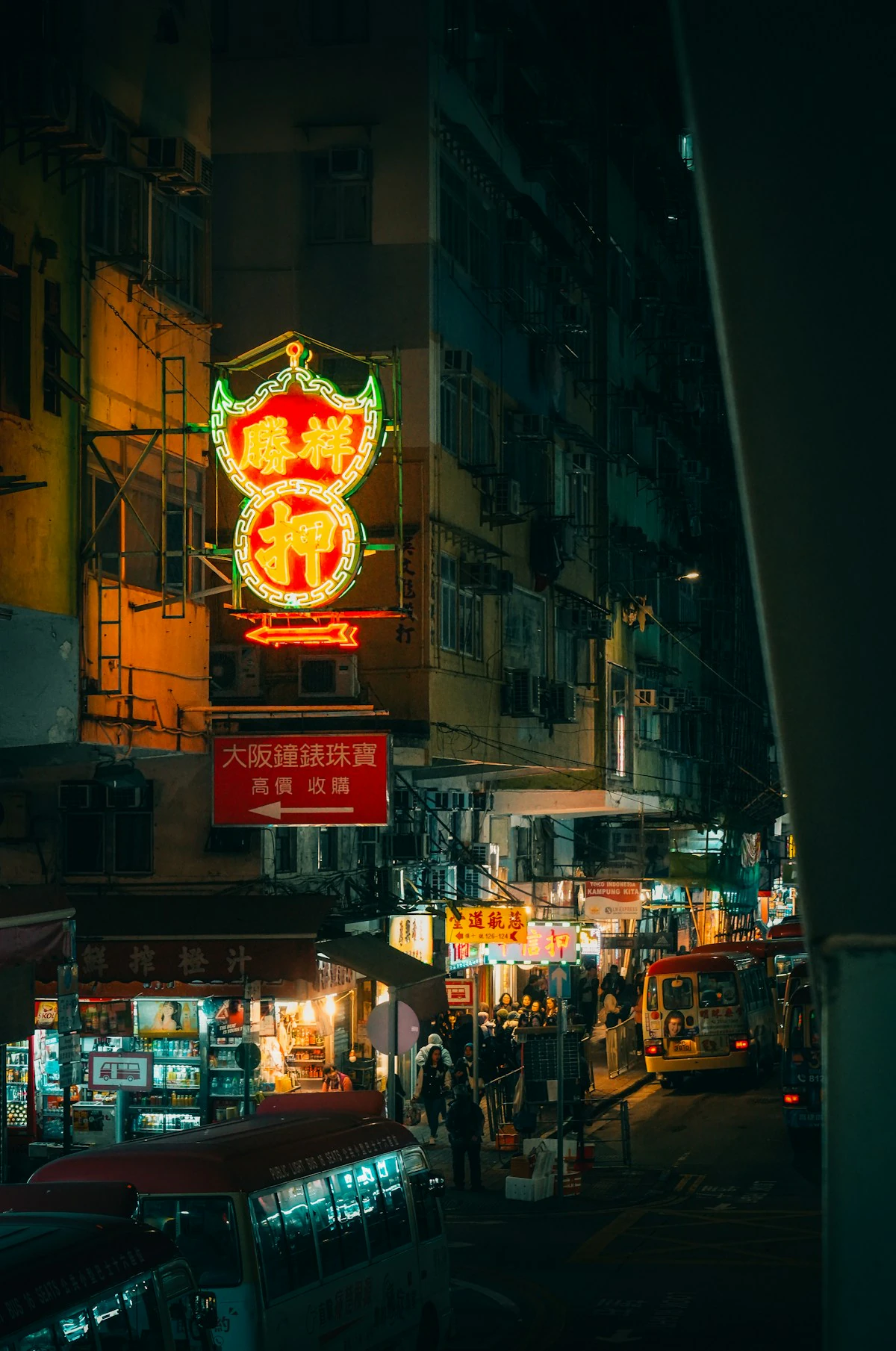
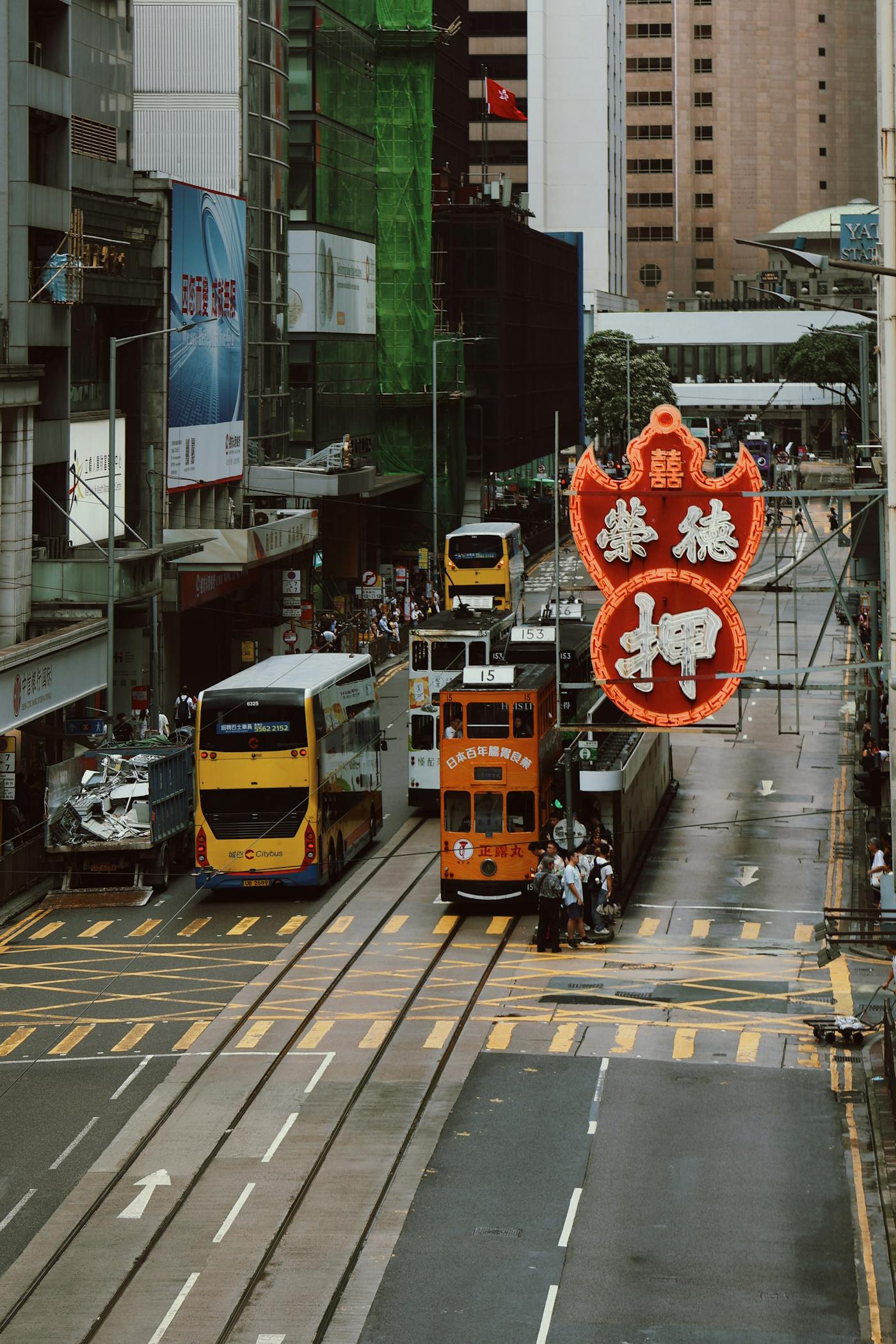
Ding Ding tram in the streets of Sheung Wan with neon signs

Right next to Central, but the vibe changes completely. This is old Chinese HK, with whole streets dedicated to herbalists, dried goods (fish, shrimp, mushrooms on Des Voeux Road West) and traditional medicine shops. It smells strong but it's fascinating. You'll also find independent art galleries and trendy cafés.

Western Market (1906) is one of the last remnants of the colonial era — the building is worth a look. And Man Mo Temple, on the border with Central: a mid-19th-century Taoist temple, incense coils hanging from the ceiling, a spellbinding atmosphere. Free entry.

Don't miss Tai Ping Shan Street, one of the very first Chinese streets in Hong Kong. Today it's a quiet pedestrian lane lined with small temples, independent cafés, craft shops and bookshops. It feels a million miles from Central next door. It fits perfectly with Man Mo Temple, PMQ and the escalator — it's on the way.

In the evening, Bar Leone: an Italian-style neighbourhood bar, voted the world's best bar in 2025 (World's 50 Best Bars). It's still relaxed, but expect a queue.
The Peak

Must-see
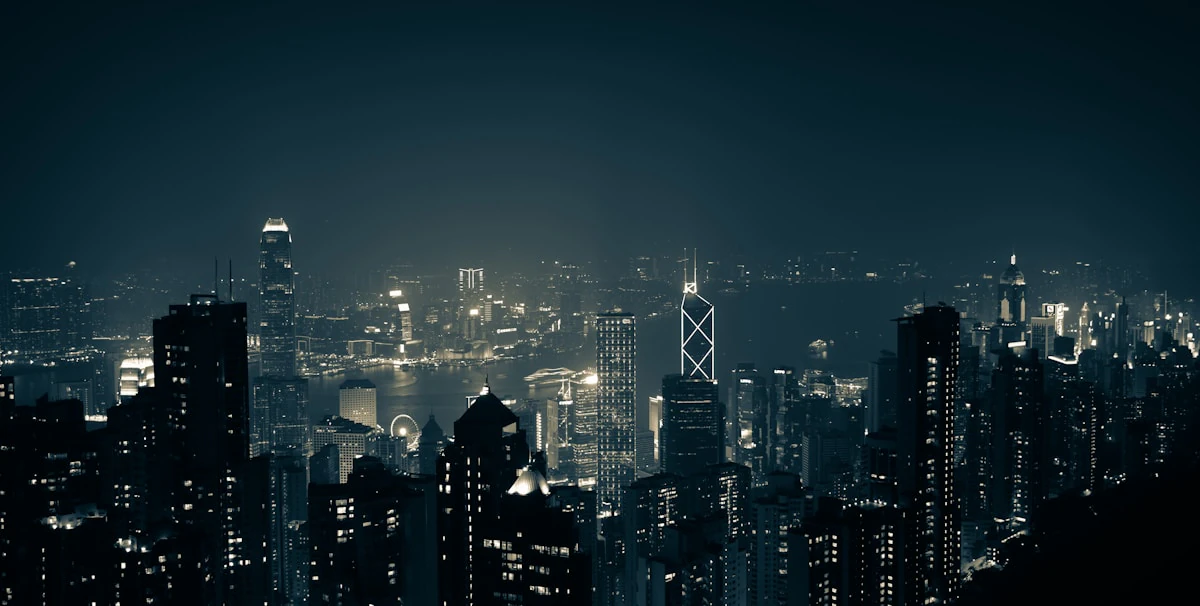
Panoramic view of Hong Kong from Victoria Peak at sunset

THE viewpoint over Hong Kong. The plan: go up in the late afternoon on the Peak Tram (fully renovated in 2022 — new cars, new system, much smoother than before). Fares: 116 HKD return (82 HKD one way), the same price every day (75 HKD return for kids and seniors). The Sky Pass (tram return + access to the Sky Terrace 428 viewing deck) comes to 182 HKD — worth it for the clear 360° view. The slope is insane. At the top, you go up through a giant shopping mall, floor by floor, to the roof. Wait for sunset: the view over the harbour, Kowloon and the skyscrapers gradually lighting up is unforgettable.

Tip: to come back down, take the bus rather than the Peak Tram. After sunset, the queue for the tram down is hellish — every tourist heads down at the same time. During the day, you can also walk down; it's a nice stroll.
Wan Chai

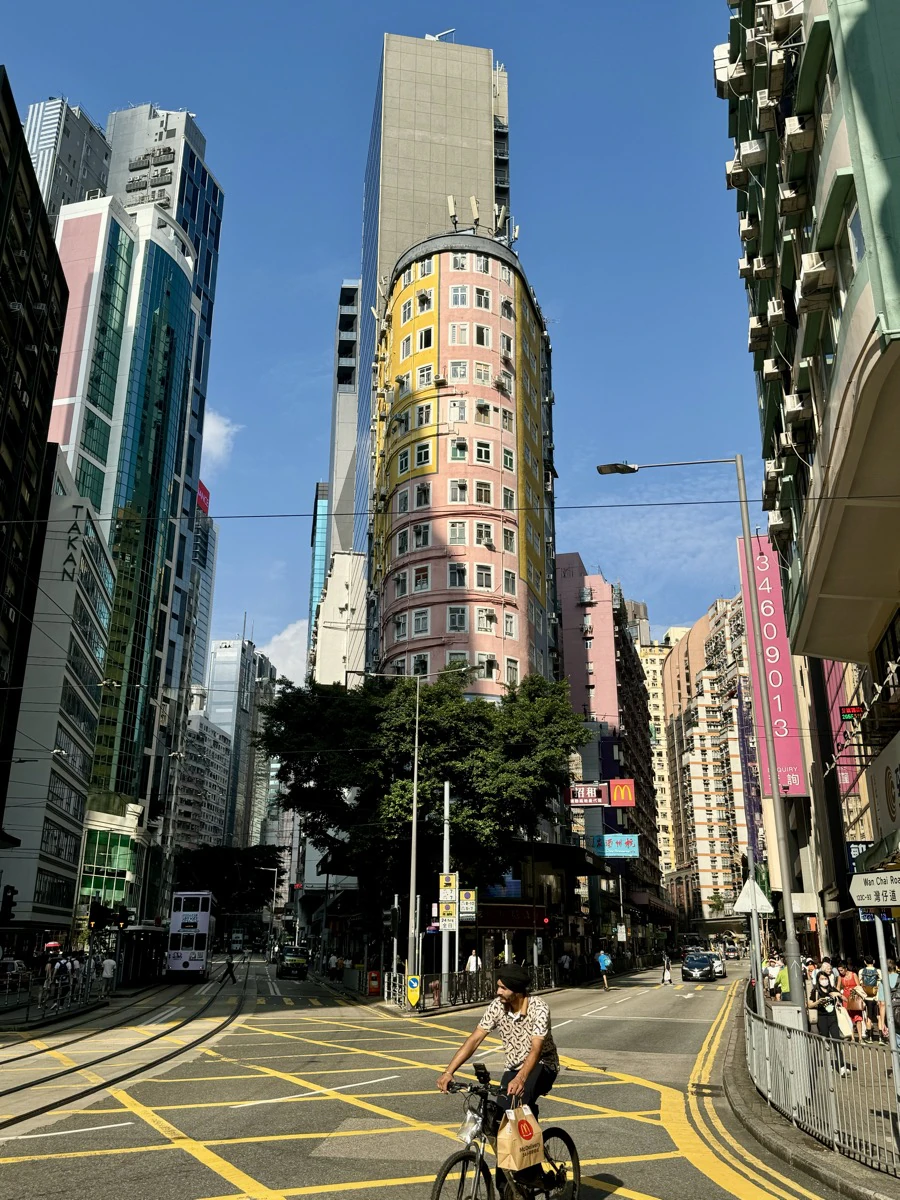
Colourful curved building and tram tracks in Wan Chai, Hong Kong

A more local neighbourhood than Central, with an interesting mix of old and new. The Wan Chai Computer Centre will delight geeks (several floors of electronics and computer gear). Wan Chai Market (258 Queen's Road East and the surrounding streets) is a real neighbourhood market: live fish, tropical fruit, medicinal herbs, and stalls spilling out into the side streets. It's where locals do their everyday shopping, not a tourist attraction — and the prices are unbeatable.

Kam's Roast Goose (226 Hennessy Road, its only branch) is an absolute must: exceptional roast goose. The queue is huge but it's worth every minute. One of the best restaurants in HK, full stop.

In the evening, Wooloomooloo Steakhouse (The Hennessy, 256 Hennessy Road): a steakhouse with a bar on the 31st floor. Great view over Wan Chai and the harbour. The rooftop terrace is now closed, but the indoor bar is still a good spot for a drink up high. Drinks are a bit pricey, but the setting is worth it.

For a more local, rock'n'roll vibe: The Wanch (54 Jaffe Road), a legendary Wan Chai institution. Live rock every night, gritty atmosphere, a crowd of regulars and zero tourists. One of the last real live music bars in HK.

Tai Hang

A hidden neighbourhood between Causeway Bay and Tin Hau. A former fishing village turned trendy spot with fusion restaurants and cafés. Zero tourists, very local. If you're there for the Mid-Autumn Festival: the Fire Dragon Dance, a 67-metre dragon covered in burning incense sticks dancing through the streets. Spectacular.

Causeway Bay

HK's shopping district. Crowds, shops everywhere, a local feel. SOGO (the iconic Japanese department store) and Times Square (a giant mall with restaurants on every floor). Nice for a wander, but not essential.

North Point — Chun Yeung Street Market

A classic street market (fruit, veg, meat, fish, dried goods) with one unique twist: the tram runs right through the middle of the market. The stalls line both sides and the ding ding squeezes its way between vendors and shoppers — a bit like Hong Kong's version of Thailand's "Maeklong Railway Market". The area is also known as "Little Fujian" or "Little Shanghai": you can still hear Chinese dialects other than Cantonese here. Very authentic, zero tourists.

Getting there: MTR North Point (Exit A1), or even better, arrive by ding ding to experience the tram rolling into the market from the inside.
Quarry Bay — Monster Buildings

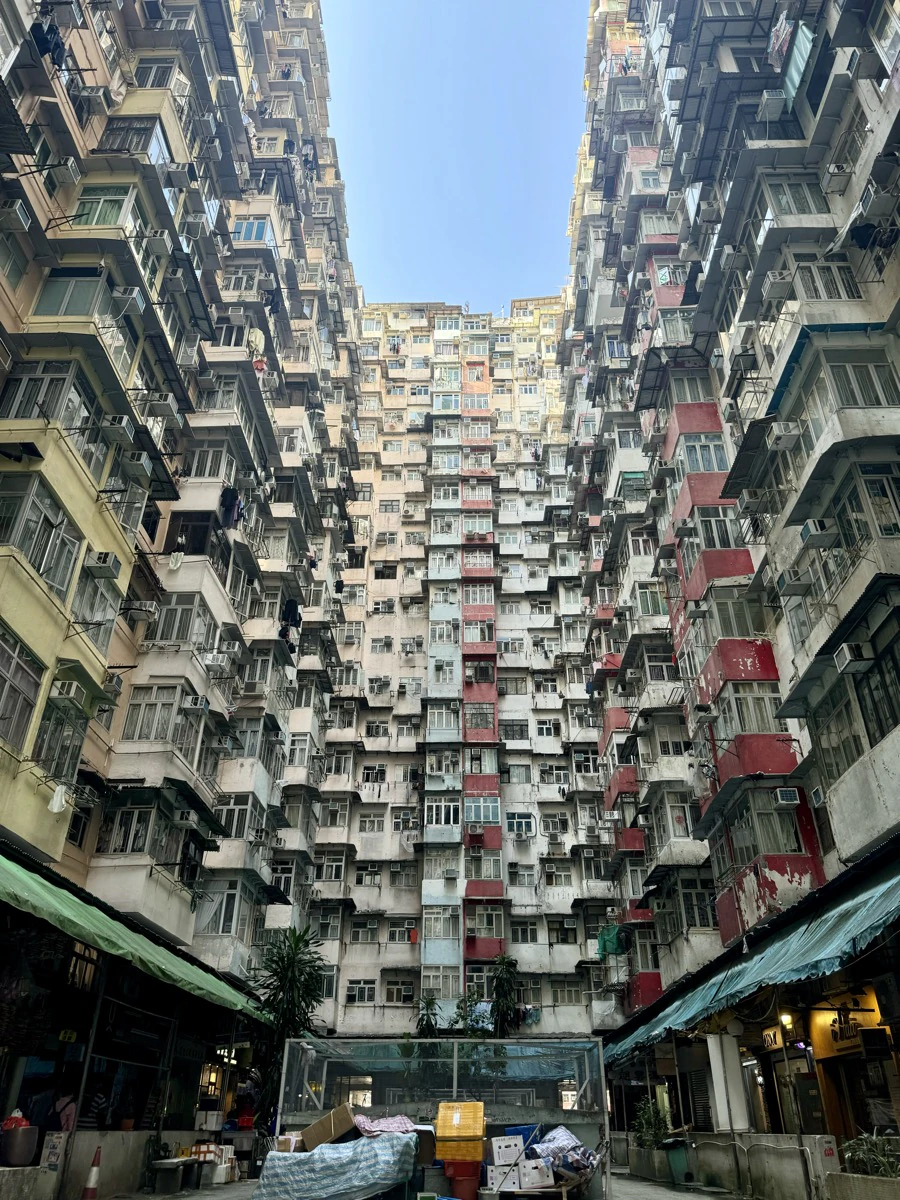
The Monster Buildings (Yick Fat Building) in Quarry Bay, towering blocks seen from the inner courtyard

The Monster Buildings (Yick Fat Building, Montane Mansion…): a cluster of 1960s residential blocks in Quarry Bay whose inner courtyard gives you a dizzying view — hundreds of flats stacked up on every side, a mind-blowing urban canyon. It's become a famous photo spot (it appears in Transformers 4). Reachable by metro (Tai Koo station). You'll spend 15 minutes there, but the image stays with you.

Be respectful: people actually live here. Keep a low profile, don't make too much noise, and respect the residents.

Happy Valley

Horse racing on Wednesday nights (in season, September to July). A unique atmosphere: Hong Kongers are crazy about the races. Entry: 10 HKD (public enclosure, pay with your Octopus). In recent seasons, entry has been free for tourists showing their passport: check the Jockey Club website to see if the offer is still on. First race around 6:40-7:10pm, last one around 11pm. You can go just for the atmosphere even if you don't bet — the beer flows and the energy is infectious.

At weekends, the racing moves to Sha Tin (New Territories) — a bigger racecourse, a more family-friendly feel, and you can combine it with the Ten Thousand Buddhas Monastery right next door.

Kennedy Town / Sai Wan

The western end of the tram line. A residential area with local restaurants and an end-of-the-world feel. Nice for a quiet end to the day, far from the tourist bustle.

Stanley

A touristy market on the south side of the Island. It's not necessarily where you'll get the best prices, but the bus ride from Central is worth it: the road hugs the coast with gorgeous views. On the way, you can hop off at Repulse Bay for the beach.
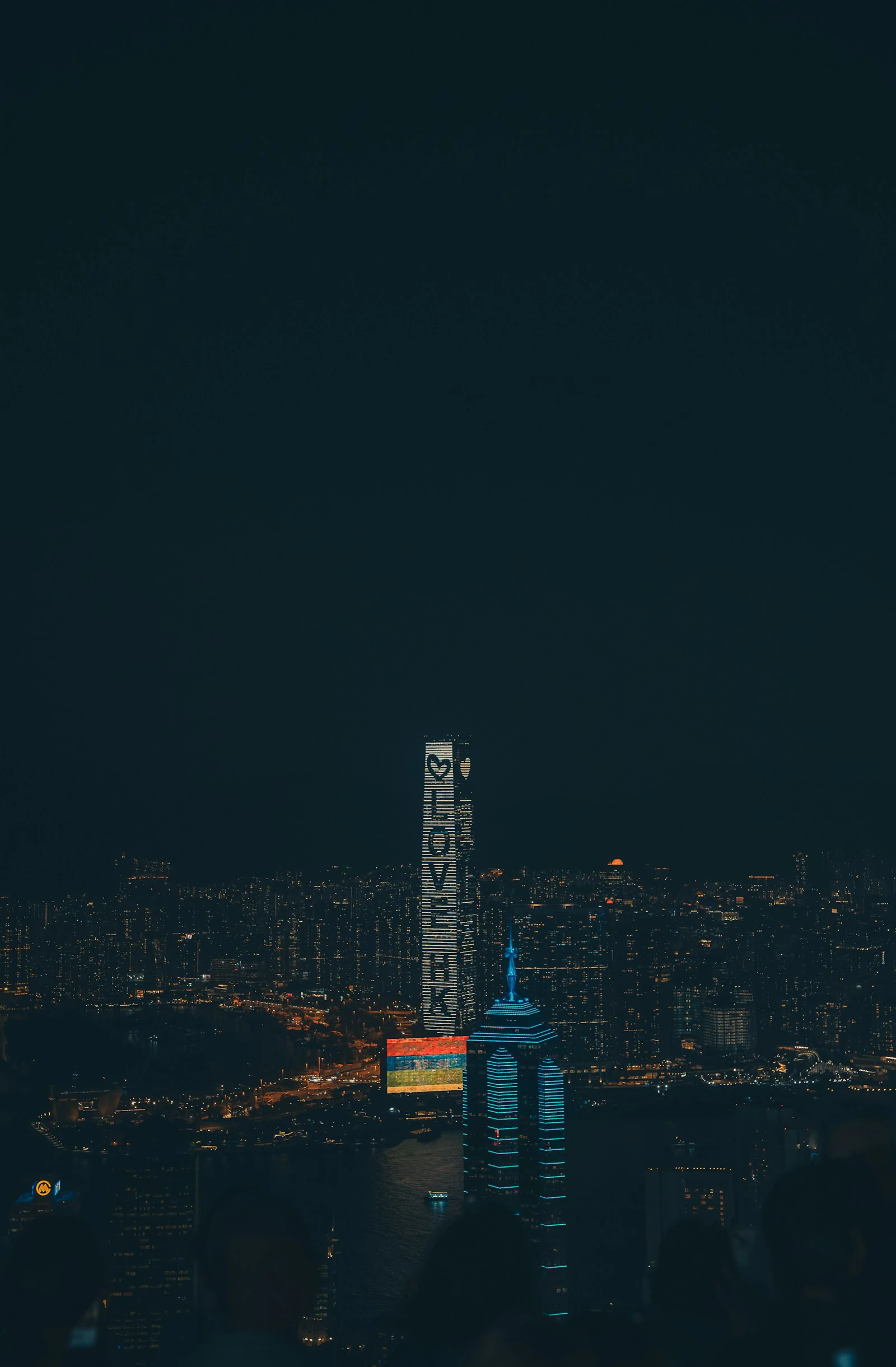
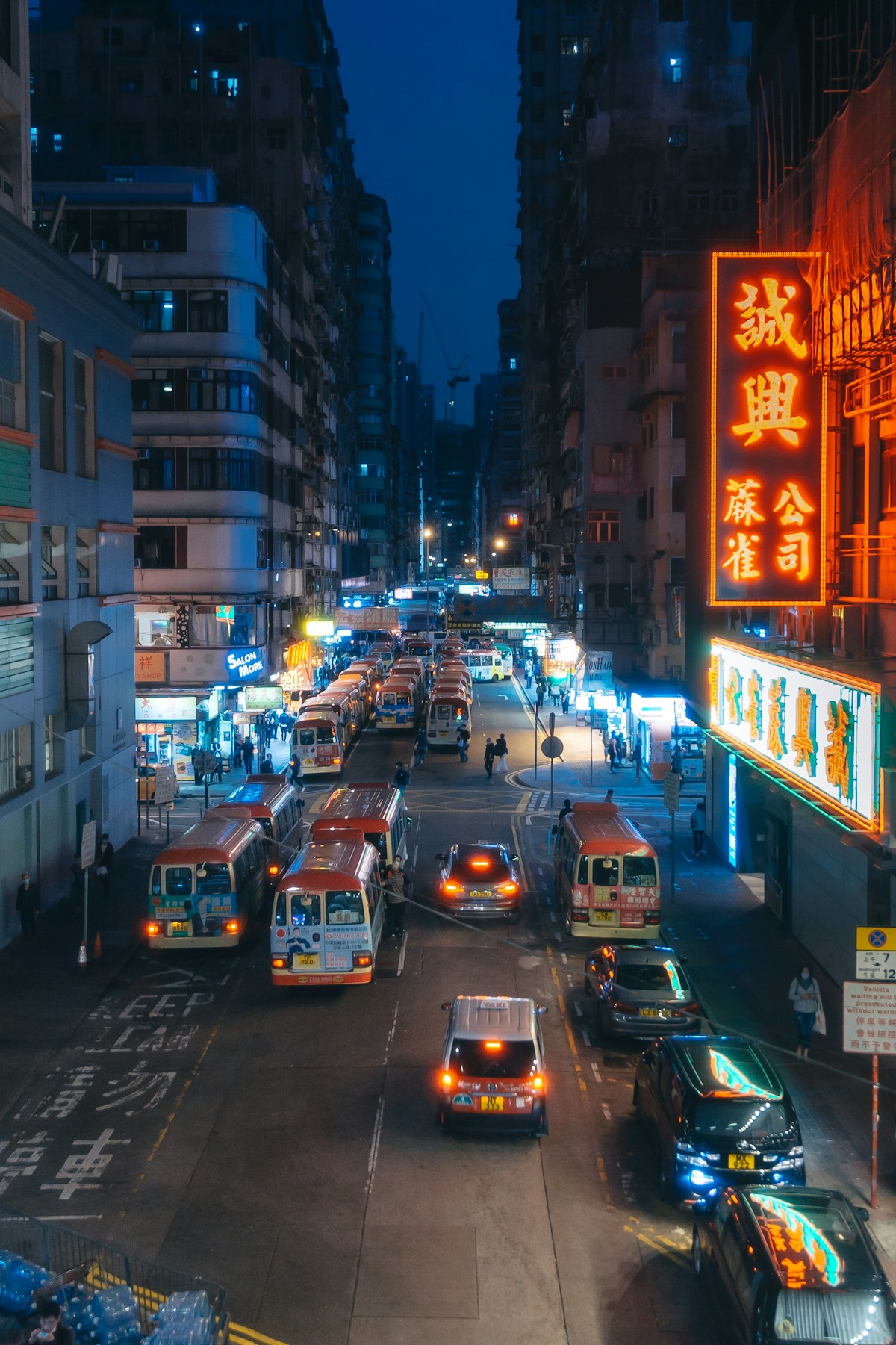
Mong Kok — neon and nightlife in Kowloon

Kowloon: neighbourhoods to explore

The big one. This is where HK really becomes HK.

Tsim Sha Tsui (TST)

Must-see
Hong Kong skyline at night with the illuminated ICC Tower, seen from the island towards Kowloon

The harbourfront district, right across from HK Island. From the island you can get there by MTR or by ferry. The Star Ferry, especially at night: it's probably the most beautiful 5-dollar ride in the world. The Hong Kong skyline lit up from the middle of the harbour is a memory that sticks with you. An absolute must, at least once.

The harbourfront promenade (Tsim Sha Tsui Promenade) is a waterside stroll facing the skyscrapers. The Avenue of Stars is HK's take on the Hollywood Walk of Fame — handprints of HK film stars (Jackie Chan, Jet Li…) and the famous Bruce Lee statue.

The Symphony of Lights, the 8pm light and sound show, ended for good on 18 November 2026, after 22 years. The tourism board has announced new light shows for 2027. Either way, the lit-up skyline from the promenade is a show in itself.

Chungking Mansions (36-44 Nathan Road): the legendary building from the Wong Kar-wai film. A crazy vertical bazaar — cheap Indian and Pakistani restaurants (the best curries in HK), guesthouses, money changers. The vibe is one of a kind, a bit chaotic but perfectly safe. Worth seeing at least once, just for the ground floor.

Sky100 (ICC Tower, West Kowloon): observation deck on the 100th floor of HK's tallest tower. The Kowloon-side answer to the Peak. And Nathan Road starts here and runs north through the whole of Kowloon.

In the evening, if you want to skip LKF on the Kowloon side: Knutsford Terrace (5 min from TST station) — a pedestrian terrace lined with bars and restaurants, with a more local, laid-back vibe. That's where people from the neighbourhood go out.

For food: One Dim Sum (G/F The Hart, 4 Hart Avenue), the biggest branch of this small chain (the original is in Prince Edward, and there's also one in Central). Really good, a huge choice, everything fresh and top quality. And for roast goose, Yung's Tangerine Peel Roast Goose has a branch at 48 Cameron Road (see Yau Ma Tei).

Jordan

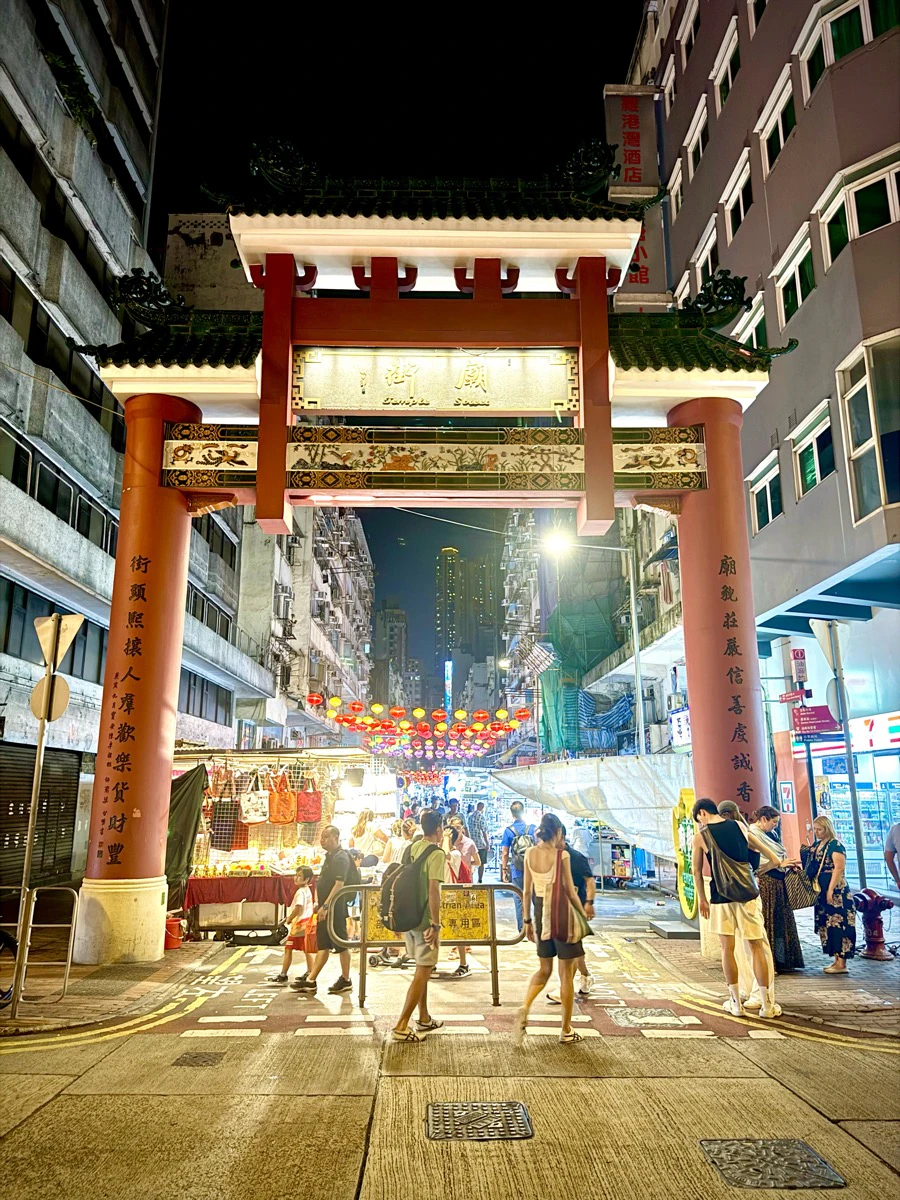
Entrance to the Temple Street Night Market with its red Chinese gate, Jordan

The Temple Street Night Market: THE night market of HK. Gadgets, street food, Cantonese opera singers. The atmosphere is wild at night. You'll also find a branch of Mak's Noodle here, if you don't feel like crossing the harbour.

Heads up: since 2026 there's less choice than before, here and at the Ladies' Market in Mong Kok. The stalls all look the same. It's still worth seeing for the atmosphere, but you might be disappointed. For gadgets, lots of people now prefer to go to Shenzhen.

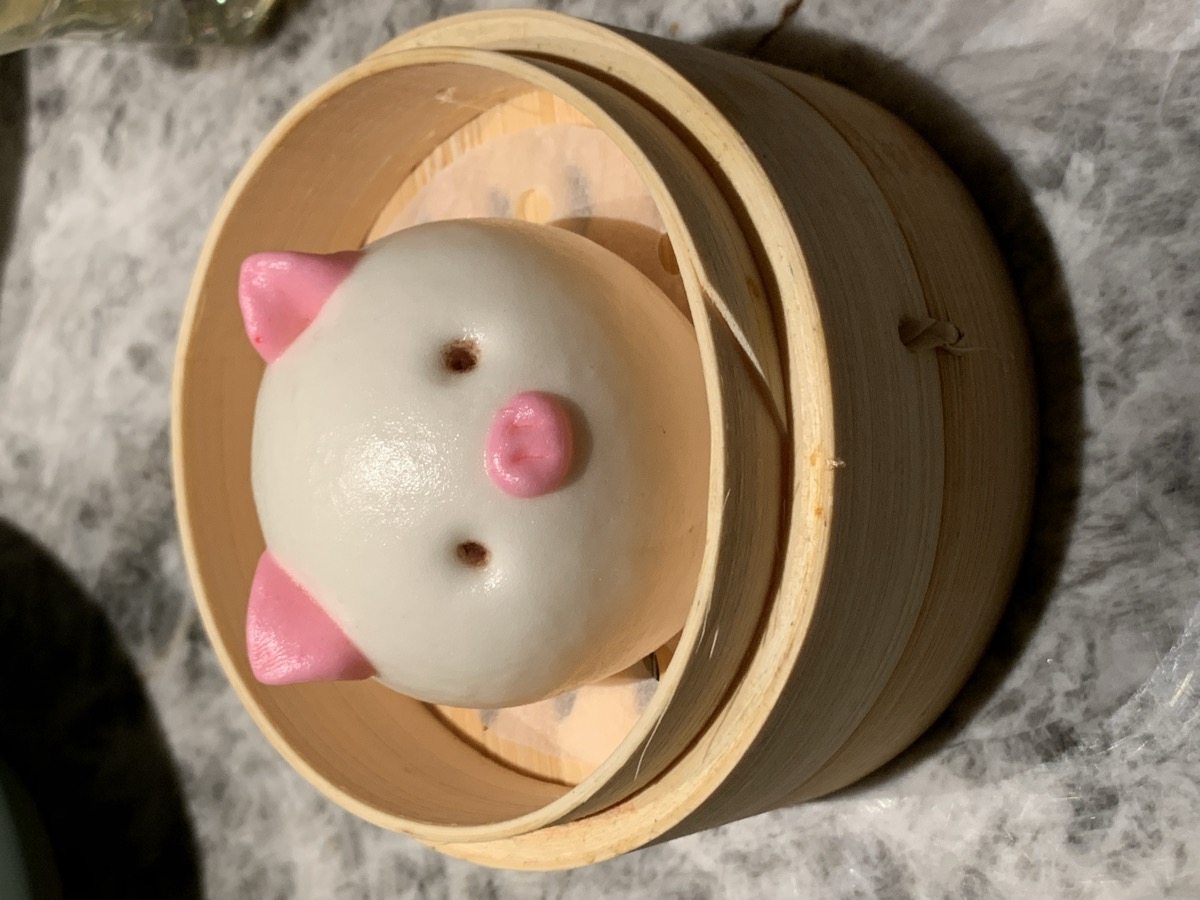
Pig-shaped piggy custard bun, a Dim Dim Sum specialty in Jordan

And above all Dim Dim Sum (28 Man Wui Street): fresh, creative dim sum, open late. Their signature: the pig-shaped piggy custard buns, filled with custard — as tasty as they are cute. Cheap, relaxed vibe.

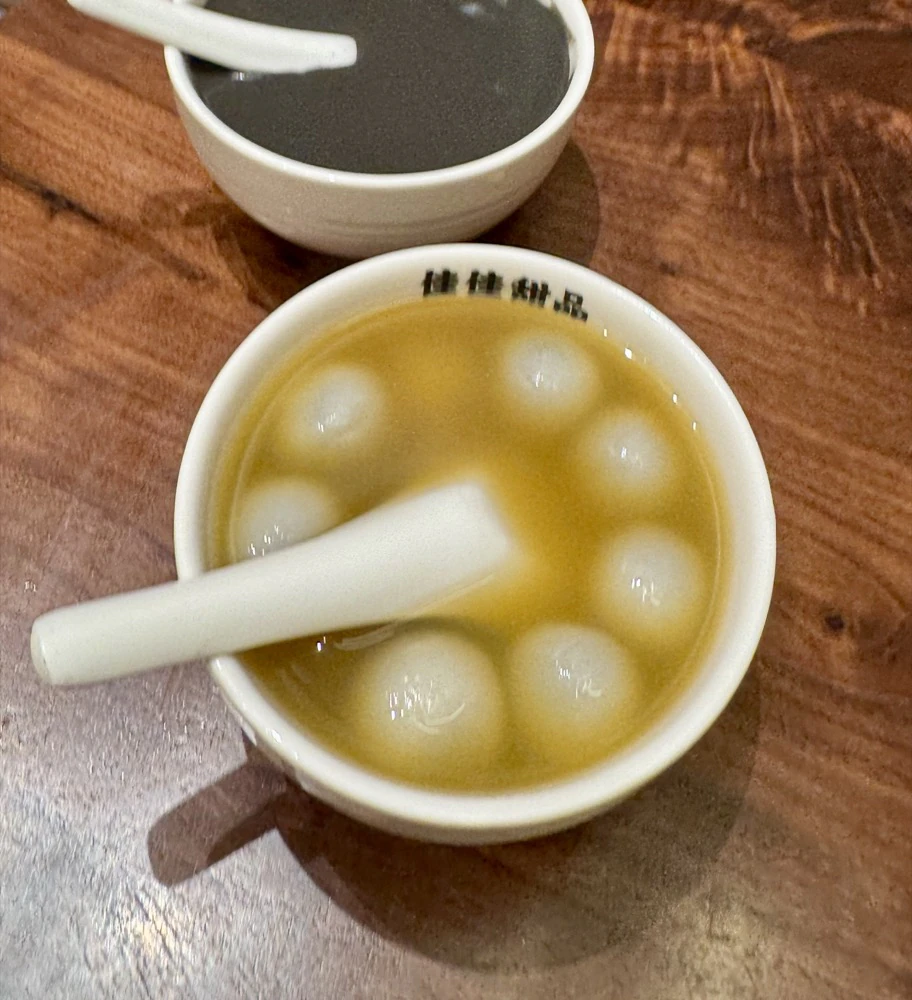
For dessert: Kai Kai Dessert (佳佳甜品, 113-115 Parkes Street, open 12pm to 1am). Recommended by the Michelin Guide and a neighbourhood institution for over 40 years. After several decades on Ning Po Street, they moved just around the corner in 2025, into a brand-new space, and it's as good as ever. My favourite: the tong yuen (湯丸), soft glutinous rice balls with a molten black sesame centre, served in a sweet ginger broth. Pure bliss.

Bowl of tong yuen in sweet ginger broth at Kai Kai Dessert, Jordan

Yau Ma Tei

Shanghai Street: an old HK street with shops selling everything — lamps, knives, hardware, kitchen utensils. The real deal. Kowloon Park gives you a bit of green in this concrete jungle. Walk through it at least once to catch your breath.

Yung's Tangerine Peel Roast Goose (榕哥陳皮燒鵝, 50-52 Portland Street, MTR Yau Ma Tei exit B2): a really good roast meat shop. Their specialty is roast goose flavoured with dried tangerine peel (陳皮). Another branch in TST (48 Cameron Road).

Mong Kok

Must-see
Busy Mong Kok street at night with neon signs and crowds

The densest, liveliest neighbourhood in HK. It's where the young crowd hangs out — buzz, noise and street food. Just wander around and go with the flow.

Ladies' Market for clothes and gadgets (less choice than before, see Jordan). Fa Yuen Street for sports shoes — dozens of sneaker shops side by side. The mobile phone mall (Argyle Street, around no. 85): several floors of smartphones and accessories. And the Richmond Commercial Building: a tiny building with collectible toy shops over 5-6 floors (figurines, models, vintage). Afternoons only — for collectors and the nostalgic.

During the day, the flower, goldfish and bird markets are impressive. Walk up towards Prince Edward following the busy streets.

The street food: open-fronted stalls with stinky tofu, skewers of anything and everything, mango desserts. It's a kind of disorganised free-for-all where you have to use your elbows and your voice to get served. Loads of young people queue up — it's really good.

For a proper meal: Paradise Dynasty (Shop 203-205, 2/F, Grand Plaza, 625-639 Nathan Road), a Shanghainese restaurant. For me, their dumplings (xiao long bao) are better than the famous Din Tai Fung's.

Prince Edward

Right next to Mong Kok. A big mall with a really good steamed-food restaurant on the top floor (30 min wait at lunchtime). One Dim Sum (15 Playing Field Road, the original — there are also branches in TST and Central): formerly Michelin-starred, still excellent and really cheap. Queue guaranteed, but it moves fast.

Wong Tai Sin

Wong Tai Sin Temple: a large, very colourful and very lively Taoist temple. Locals come to burn incense, have their fortunes told with fortune sticks, and pray. Far more authentic and less touristy than some of the temples downtown.

A 10-minute walk away, Tai Shing Market (between Wong Tai Sin and San Po Kong) is one of the biggest markets in Kowloon: 390 stalls, including around thirty seafood stalls and a dozen butchers. A neighbourhood where tourists never set foot — real working-class Kowloon.

Kowloon City

Hidden gem

The neighbourhood nobody puts in guidebooks, which is a real shame. Kowloon City is THE capital of Thai food in Hong Kong — the city's biggest Thai community has lived here for decades. The Thai restaurants are authentic, cheap, and nothing like what you'll find elsewhere in town.

On the Cantonese side, the old streets around Nga Tsin Wai Road are packed with little old-school places — roast meats, congee, desserts. This is working-class Kowloon, not a tourist in sight, with spots that haven't changed in 30 years.

And right next door: Kowloon Walled City Park, a classical Chinese garden built on the site of the old Walled City — the infamous lawless enclave that was demolished in 1994. The park is peaceful and free, with signs telling the crazy story of the place.

Getting there: Sung Wong Toi station (Tuen Ma line, opened in 2021), then about ten minutes on foot to the Walled City Park. The area was cut off from the MTR for a long time, and you can still feel it: that's part of the charm.

Sham Shui Po

Must-see
Typical street market in a working-class Hong Kong neighbourhood

The working-class neighbourhood par excellence. This is the real HK, unfiltered and tourist-free. Two sides to it: the geeky side with the Golden Computer Arcade (computers, components, games) and Apliu Street (electronics flea market, gadgets, old stuff). And the everyday side, with cheap street food, fabric shops and haberdasheries. The anti-Central.

Tim Ho Wan (the original Sham Shui Po location): once Michelin-starred, now Bib Gourmand. Since it became a chain, quality has been more hit-and-miss — but the SSP branch is still the best. Dim sum at ridiculously low prices. The BBQ pork buns (baked buns filled with char siu) are their signature. Queue here too.

Whampoa

Easy to reach by MTR (Whampoa station, Kwun Tong line). A boat-shaped shopping mall in the middle of the city, and above all an entire tower devoted to food, with loads of different specialties. All really good.

75% of Hong Kong is nature — view from the trails

Hong Kong's islands & New Territories

Hilltop temples, giant Buddhas, fishing villages and car-free islands.

Ten Thousand Buddhas Monastery

Must-see
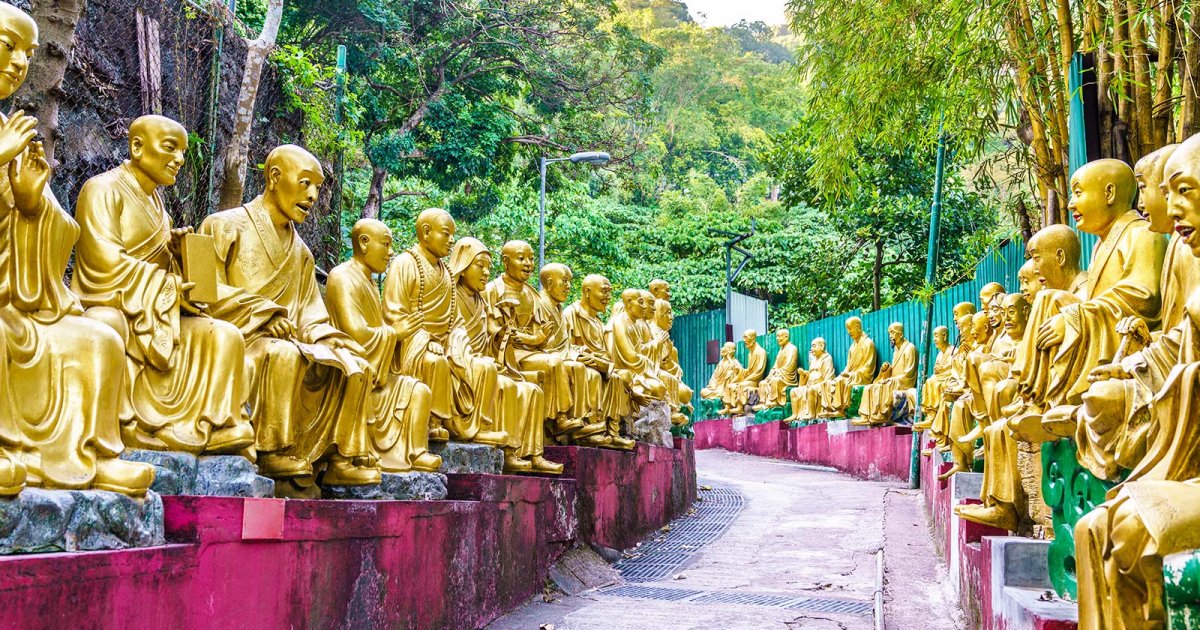
Golden statues lining the path to the Ten Thousand Buddhas Monastery, Sha Tin

In Sha Tin, in the New Territories. There are actually way more than 10,000. You have to earn it: the way up is a steep path lined with hundreds of golden Buddha statues, every one different, in all sorts of poses. Some are pretty wacky. At the top, the monastery sits on the hillside with a view over Sha Tin. Impressive and one of a kind.

Take the MTR (Sha Tin station), then 15-20 min of walking and climbing.

Lantau — Big Buddha

Must-see
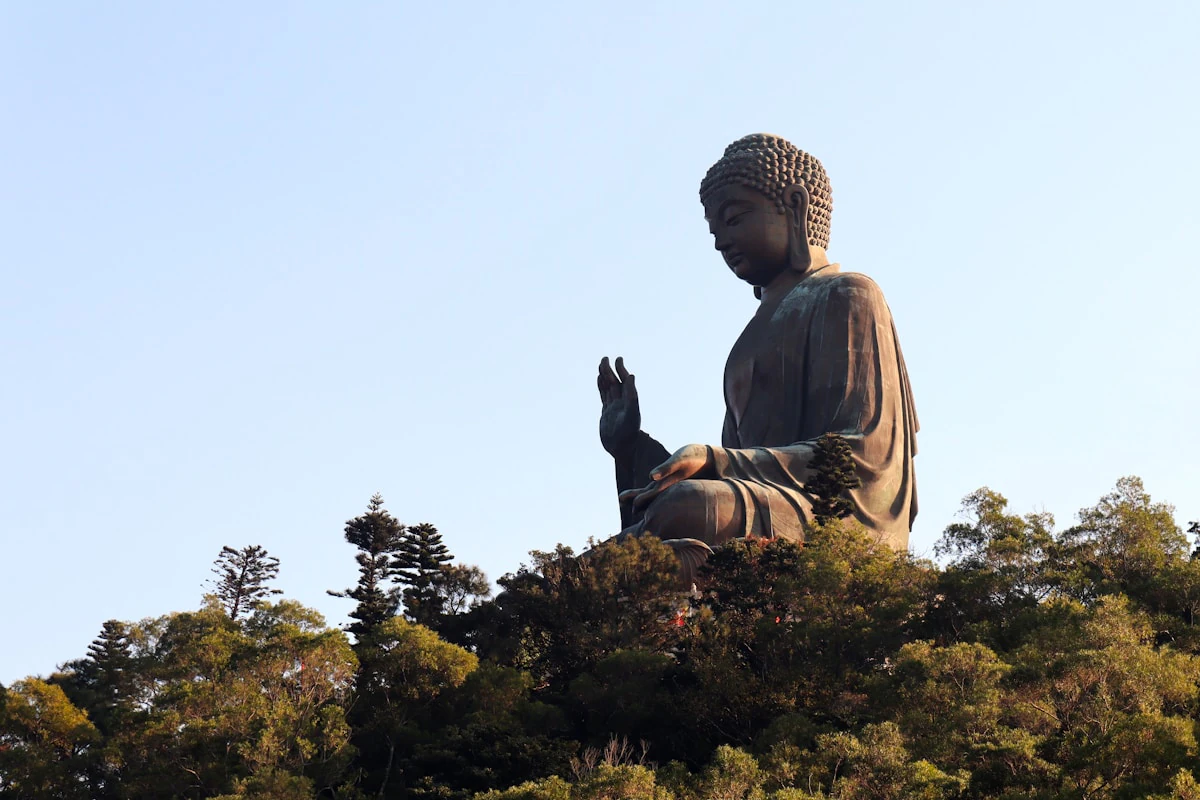
Close-up of the Big Buddha (Tian Tan Buddha) on Lantau Island, Hong Kong

HK's biggest island (it's where the airport is). The Big Buddha at Ngong Ping (you can spot it in Tsui Hark's Knock Off with Van Damme, 1998): you get up there by cable car (Ngong Ping 360, the "eggs" — a 25-min ride with views over the sea and mountains).

Heads up: it's become very touristy. At the top, you have to walk through "Ngong Ping Village", a whole street of souvenir shops and tourist traps. It's annoying, but the Buddha (268 steps) and above all the monastery are worth it.

There's a vegetarian restaurant run by monks. You HAVE to eat there: the menu is amazing — they recreate every meat dish with tofu so well you'd swear it's the real thing. Chicken, pork, fish… except it's all tofu.

Tai O, at the other end of the island: a fishing village on stilts. Feels frozen in time — houses over the water, dried fish everywhere. You can do Big Buddha + Tai O on the same day.

Lamma Island

30 min by ferry from Central. A car-free island. You land in a small village, eat some tofu fa (silken tofu pudding with ginger syrup and brown sugar — delicious), walk across the island to the other village, and catch the ferry back. A nice walk, with a beach on the way. A total change of scene.

Cheung Chau

A small island reachable by ferry from Central (~35 min). Fishing-village vibe, pedestrian lanes, temples, beach. Perfect for a quiet half-day if you have time.

Hiking in Hong Kong

Not the first thing you'd think of, but Hong Kong is 75% nature. The hikes are superb.

🟢 Dragon's Back — Easy

THE best-known and most accessible hike in HK. 8.5 km, about 4h, difficulty 3/10. Spectacular views over Shek O and Big Wave Bay. Perfect even if you're not a hiker. Reachable by bus from the island.

🟢 Half Moon Bay — Easy

In Sai Kung: take a kaito (small boat) from the pier, a 20-min crossing. A gorgeous crescent-shaped beach with crystal-clear water. You can also hike around Sharp Island between the beaches. One of the most beautiful beaches in HK.

🟡 Siu Ma Shan & Tai Tung/Tai Tan — Moderate

Siu Ma Shan gives you a panoramic view over the New Territories (Ma On Shan area). Tai Tung and Tai Tan, on the Sai Kung side: coastal trails in the country park, with gorgeous scenery.

🔴 Lion Rock — Tough

6.9 km, difficulty 7/10. THE symbol of Hong Kong for locals. 360° panoramic views over all of Kowloon and the island from the summit (495m). The climb is steady, but the last 300 metres are very steep — steps cut into the rock, exposed sections. The HK government lists Lion Rock among its 16 "high risk locations" for hikers. Very rewarding, but you need to be comfortable with steep ground. The city's most iconic hike.

🔴 Suicide Cliff (Kowloon Peak) — Tough

6.8 km, 695m elevation gain, difficulty 8/10. THE Instagram hike of Hong Kong. From the top of Kowloon Peak (Fei Ngo Shan, 602m), you reach Suicide Cliff: a dizzying cliff with a spectacular plunging view over all of Kowloon, the harbour and HK Island. At sunset, it's breathtaking. Start from MTR Choi Hung, a steep climb with lots of steps, then a rocky trail.

⚠️ Safety: for experienced hikers only. The cliff has no railing, the ground is loose gravel, and the descent is technical, with sections where you need to use ropes. Don't go alone, or in wet or windy weather. Allow 4h including breaks.
Dim sum — Hong Kong, a food lover's paradise

Where to eat in Hong Kong

Hong Kong is food heaven. You eat incredibly well for very little money.

The golden rule

Look at the queue. The more people waiting, the better it is. If the place is packed and there are people standing around waiting, go for it. If it's empty, be suspicious. In shopping malls, there's always a floor (often the top one) given over to restaurants — a good fallback when you don't know where to eat.

Cha Chaan Teng (茶餐廳)

Hong Kong's no-frills café-diners. It's THE local canteen — there's one on every street corner. Formica, neon lights, fast service, laminated menus. You go there for:

HK milk tea: super-strong milk tea strained through a stocking (yes, a stocking). Addictive. The polo bao (pineapple bun): crunchy on top, soft inside, with a slab of butter in the middle. No pineapple in it despite the name. French toast (西多士): two thick slices of white bread with peanut butter in between, dipped in egg, deep-fried, drizzled with syrup and topped with a knob of butter. An absolute calorie bomb, and fantastic. And for breakfast: macaroni soup with ham and egg. It's surprising the first time, but you get used to it very fast.

The legendary spot: Lan Fong Yuen (蘭芳園), 2 Gage Street, Central. Founded in 1952, it's one of the oldest cha chaan teng in HK, tucked under the giant escalator. This is where "silk stocking milk tea" was invented. The pork chop bun and the French toast are legendary.

Sunday Yum Cha

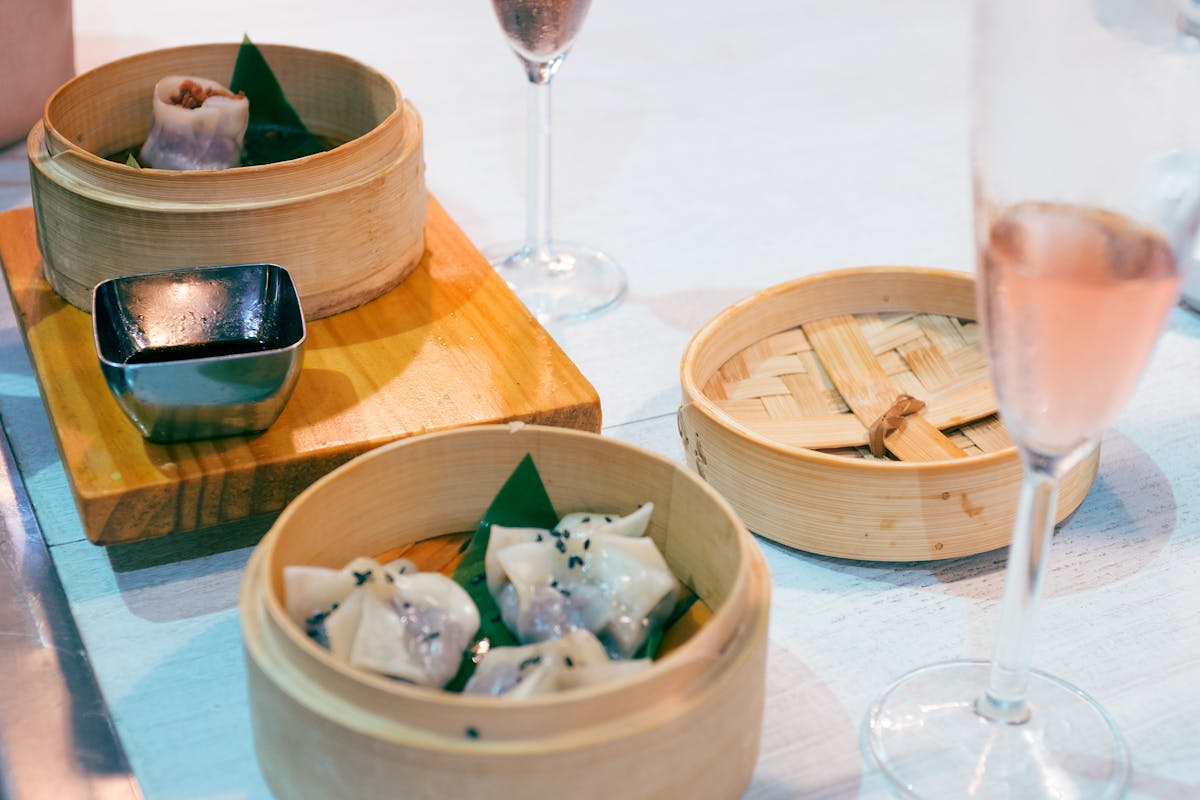
Dim sum in bamboo steamer baskets, a Hong Kong specialty

Going for dim sum on Sunday morning is THE Hong Kong family ritual. You sit at a big round table, carts loaded with steamer baskets and small plates roll between the tables, and you point at what you want. You have to experience it at least once. Get there early (before 10am) or the queue is endless.

My favourite restaurants in Hong Kong

Price per person: $ under 100 HKD · $$ 100 to 250 HKD · $$$ over 250 HKD

★ Institution $

Mak's Noodle

Noodles and shrimp wontons (wan tan min). Wellington St, Central + a branch in Jordan.

★ Legendary queue $$

Kam's Roast Goose

226 Hennessy Rd, Wan Chai (its only branch). Outstanding roast goose. The queue is huge but every minute is worth it.

★ 1 Michelin star $$

Yat Lok

34-38 Stanley St, Central. Roast goose in a tiny hole-in-the-wall. Michelin-starred yet cheap. Gruff service.

Dumplings $

Dumpling Yuan

98 Wellington St, Central (the sign may now read “Dumpling Place”). All kinds of dumplings, excellent. Easy to combine with Mak's right next door. Cash only.

Ex-Michelin star $

One Dim Sum

15 Playing Field Rd, Prince Edward (the original) + 4 Hart Ave, Tsim Sha Tsui (the biggest). Cheap, excellent dim sum, wide choice, everything's fresh. There's a queue but it moves fast.

Ex-Michelin star $

Tim Ho Wan

Sham Shui Po (the original location). Now a chain — quality varies from branch to branch, but the SSP one is still the best. Legendary BBQ pork buns. Cheap.

★ Fun & delicious $

Dim Dim Sum

28 Man Wui St, Jordan. Fresh, creative dim sum, open late. Their signature: pig-shaped piggy custard buns — as tasty as they are cute. Cheap, laid-back vibe.

Shanghainese $$

Paradise Dynasty

Grand Plaza, 2/F, 625-639 Nathan Rd, Mong Kok. Shanghai soup dumplings (xiao long bao). For me, better than the ones at the famous Din Tai Fung.

Roast goose $$

Yung's Tangerine Peel Roast Goose

50-52 Portland St, Yau Ma Tei + 48 Cameron Rd, TST. A really good roast meat shop, roast goose with tangerine peel.

★ Dessert $

Kai Kai Dessert

113-115 Parkes St, Jordan. Traditional desserts, Michelin-recommended. Freshly renovated, still as good as ever. What to order: black sesame tong yuen in sweet ginger soup.

Must-try

Egg tarts: crisp shortcrust pastry, silky custard. THE Hong Kong afternoon snack. The two best spots: Tai Cheong Bakery (35 Lyndhurst Terrace, Central — since 1954, shortcrust) and Honolulu Coffee Shop (176-178 Hennessy Rd, Wan Chai — puff pastry). Both styles are equally good, it's a matter of taste.

Bubble waffles (鷄蛋仔): the bubble-shaped waffle, crispy outside, fluffy inside. THE Hong Kong street snack, eaten hot while you walk. Lee Keung Kee (492 King's Road, North Point — the original, Michelin-recommended) and Mammy Pancake (Mong Kok — the best known, creative flavours).

And the mango desserts at Hui Lau Shan (a chain): you absolutely have to go, even if they now do a lot more than just mango.

Day trips from Hong Kong: Macau and Shenzhen

Macau

You can get there by ferry (1h) or by bus over the Hong Kong–Zhuhai–Macau Bridge. A former Portuguese trading post, it's mostly famous for its casinos — and yes, it really is the Las Vegas of Asia. But there's also a UNESCO-listed historic centre that's worth the trip: the Ruins of St. Paul's (a baroque façade in the middle of town), Rua do Cunha in Taipa (a pedestrian lane packed with Macanese street food), and the Lord Stow's egg tarts in Coloane — the best in the region, with caramelised puff pastry. Macanese cuisine is a Portuguese-Chinese mix you won't find anywhere else: minchi, bacalhau, serradura.

That said, for a first trip to HK, Macau isn't a priority. If you have 3-5 days, spend them in HK. Macau is for a second visit or if you have extra time.

Shenzhen

A Chinese city just across the border, 20-40 min by train from Kowloon. Visas: French citizens can stay up to 30 days without a visa, a measure valid until 31 December 2026 (check whether it's been extended). Many other European passports have the same deal; for other nationalities, the rules vary.

Shenzhen has become China's most futuristic city. For shopping, Luohu Commercial City (right outside the station) is still an 8-storey vertical mall where you can find everything — tailor-made clothes, massages, hairdressers, restaurants — at ridiculously low prices. But beyond the mall, the city is worth a visit for its tech and creative side: the OCT Loft district (old warehouses turned arts hub, with galleries and cafés), Nanshan (home to the headquarters of Tencent, DJI and Huawei), and the futuristic malls of Futian. For gadgets and electronics, lots of people now prefer Shenzhen to the HK markets: Huaqiangbei is the biggest electronics market in the world. You pay for everything with WeChat Pay or Alipay — bring cash or set up the app before you go.

Itineraries: Hong Kong in 3 or 5 days

Two options depending on how much time you have. Adapt them to what you're into.

Day 1 — Hong Kong Island

Breakfast at Lan Fong Yuen (Gage Street, under the escalator — milk tea + French toast). Then Central Market (open from 10am, free and air-conditioned), where the giant Mid-Levels escalator starts. Head back down via Hollywood Road: Tai Kwun and PMQ on the way — note that the PMQ studios only open at noon, so in the morning you only get the architecture. Then Man Mo Temple and the backstreets of Sheung Wan (Western Market, dried goods). Lunch on Wellington St (Mak's Noodle or Dumpling Yuan), then an egg tart at Tai Cheong Bakery just around the corner. Afternoon: Hong Kong Park, iconic buildings, the Ding Ding to Wan Chai and Causeway Bay. Late afternoon: up to the Peak on the Peak Tram for sunset. Come back down by bus. Evening: drinks in Soho / Staunton Street (chilled) or Lan Kwai Fong (party). For a rooftop bar: Wooloomooloo on the 31st floor (256 Hennessy Road, Wan Chai).

Day 2 — Kowloon

Star Ferry from Central to TST. Harbourfront promenade, Avenue of Stars, Chungking Mansions (ground floor). Walk up Nathan Road, lunch on the way. Yau Ma Tei (Shanghai Street), then Mong Kok: Fa Yuen Street for sneakers, the flower, fish and bird markets. Bubble waffle at Mammy Pancake, skewers and stinky tofu along the way. Evening: Temple Street Night Market (Jordan). Back on the Star Ferry at night — the lit-up skyline from the middle of the harbour is the best memory of HK.

Day 3 — Lantau or Sha Tin

Option A: Big Buddha + Tai O. Ngong Ping 360 cable car in the morning, vegetarian lunch at the monastery, bus to Tai O in the afternoon.
Option B: Ten Thousand Buddhas Monastery in the morning (Sha Tin — a must), then afternoon in Sham Shui Po (Golden Computer Arcade, Apliu Street, dim sum at Tim Ho Wan).

Days 1 & 2 — HK Island + Kowloon

Same as the 3-day itinerary (see above).

Day 3 — Lantau

Ngong Ping 360 cable car in the morning (25 min, spectacular views). Walk through Ngong Ping Village (touristy, don't linger) and climb the 268 steps to the Big Buddha. Vegetarian lunch at the monastery (don't miss it). Bus to Tai O in the afternoon — a fishing village on stilts, frozen in time.

Day 4 — Temples, nature and beach

Morning: Ten Thousand Buddhas Monastery in Sha Tin (MTR, then a 20-min climb lined with golden statues). Afternoon, take your pick: the Dragon's Back hike (easy, 4h, spectacular views) or Half Moon Bay in Sai Kung (kaito boat + a paradise beach). Evening: Happy Valley if it's a Wednesday (horse racing, cheap beer).

Day 5 — Local neighbourhoods or an island

Option A — Working-class Kowloon: Morning at Wong Tai Sin temple (fortune-telling, incense), then on to Kowloon City for a Thai or old-school Cantonese lunch. Afternoon in Sham Shui Po (Golden Computer Arcade, Apliu Street, dim sum at Tim Ho Wan). Evening: one last Star Ferry at night.
Option B — Island: A lazy day on Lamma Island (30-min ferry from Central, walk across the island, tofu fa, beach) or Cheung Chau. Back in the late afternoon, one last wander around Mong Kok for street food.

Practical info

When you land at the airport, there's a tourist information stand (right after baggage claim). Ask for the little "Hong Kong Walks" booklet if they still have it: it's really well done. It guides you through the historic neighbourhoods on the island (the streets of spices, herbal doctors, dried goods). Grab one, no question.

Sundays in Hong Kong — a sight like nowhere else

If you're in HK on a Sunday, don't miss this. Since the 1980s, every Sunday, thousands of Filipina domestic workers take over Statue Square and the open ground floor of the HSBC building in Central. They turn these spaces into a huge open-air living room: card games, hairdressing, shared home cooking, karaoke, dancing, chatting... They gather by home region in the Philippines — each group has "its" spot, every week, for years.

And it doesn't stop there: in Victoria Park (Causeway Bay), it's the same scene with Indonesian domestic workers.

It's joyful, noisy, alive — and it's an integral part of Hong Kong culture. The whole city feels different on Sundays. Wander between Statue Square and Central's giant escalator: it's another world.

Who writes this guide?

I'm Eric. I fell for Hong Kong in 1995, back when it was still a British colony. Since then I've been back more than 25 times, and I still love it every time.

In thirty years I've watched the city change: neighbourhoods transformed, legendary spots gone, new ones popping up. But the essentials are still there: Mong Kok buzzing at night, the Star Ferry after dark, Sunday-morning dim sum, a tong yuen at Kai Kai.

This guide is everything I wish I'd known before my first trip. My neighbourhoods, my restaurants, my hikes, tried and tested again and again. Just my places and my opinions, no filter.